
Losing a tooth, whether through decay, injury, or gum disease, is more common than many people realise, and finding the right replacement option can feel overwhelming. If you have been researching dental implants near Whitton, you are probably weighing them up against other options like bridges or dentures.
In this guide, we will explain how dental implants work, who they tend to suit, and how they compare to other tooth replacement options. By the end, you should have a clearer sense of whether implants could be the right solution for your particular situation.
What Is a Dental Implant?
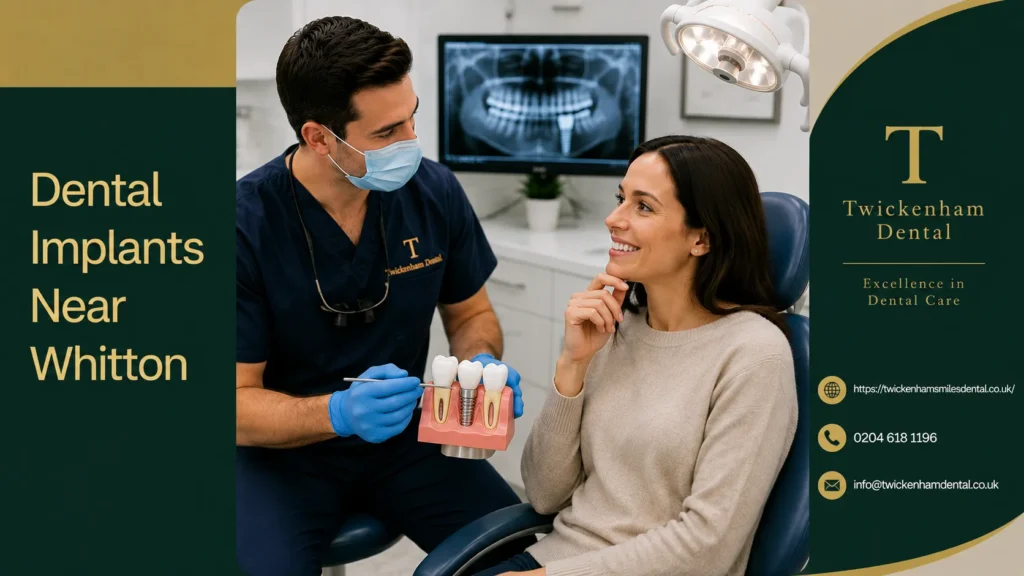
In short: a dental implant is a small titanium post surgically placed into the jawbone to replace the root of a missing tooth, onto which a crown, bridge, or denture can later be fitted to restore the appearance and function of the missing tooth or teeth.
Unlike removable dentures, an implant is designed to integrate with the jawbone over time, creating a stable foundation that functions in a similar way to a natural tooth root.
Why People Near Whitton Consider Dental Implants
Patients typically start exploring implants after experiencing one or more missing teeth, whether from an accident, advanced decay, or long-standing gum disease. Common motivations include:
- Wanting a more permanent solution than a removable denture
- Struggling with an ill-fitting or uncomfortable denture
- Concerns about bone loss in the jaw after losing a tooth
- Wanting to restore normal chewing function
- A desire for a replacement tooth that looks and feels natural
For many patients across Whitton, Hounslow, and Isleworth, the appeal of implants lies in their stability and the fact that they do not rely on adjacent teeth for support, unlike a traditional bridge.
How Dental Implants Compare to Other Options
Implants vs Dentures
Dentures are removable and sit on top of the gums, which can sometimes lead to movement while eating or speaking. Implants, by contrast, are fixed in place, which many patients find more comfortable and stable during everyday use.
Implants vs Bridges
A traditional dental bridge typically requires the adjacent teeth to be shaped down to support the new tooth. An implant avoids this, as it does not depend on neighbouring teeth for support, which can help preserve more of your natural tooth structure.
Implants and Bone Health
One lesser known benefit of implants is their effect on the jawbone. Because an implant replaces the tooth root itself, it can help maintain bone structure in that area, whereas the jawbone beneath a missing tooth can gradually change shape over time without that stimulation.
Are Dental Implants the Right Choice for You?
Dental implants tend to suit patients with adequate jawbone density and generally good oral health, though this varies from person to person. Some patients may need additional preparation, such as a bone graft or sinus lift, before an implant can be placed successfully.
The only way to know whether implants are suitable for you is through a proper clinical assessment, which typically includes an examination and imaging such as an OPG or CBCT scan to evaluate the jawbone. You can book a consultation with Twickenham Dental Practice to find out whether implants are a realistic option for your situation.
Who Might Need to Consider Alternatives
- Patients with significant bone loss who have not had preparatory treatment
- Patients with certain uncontrolled medical conditions
- Those seeking a faster, lower cost solution, where a bridge or denture may be more appropriate
If implants are not the right fit, your dentist can talk through alternative options within our general dentistry and prosthetics services.
Replacing Multiple Missing Teeth: All-on-4
For patients missing several or all of their teeth in one jaw, All-on-4 implants offer an alternative to traditional full dentures, using four strategically placed implants to support a full arch of replacement teeth. This approach can reduce the number of implants needed compared to replacing every tooth individually, although suitability still depends on an individual assessment.
What to Expect During Implant Treatment
Implant treatment usually begins with a thorough consultation and imaging to assess bone structure and plan the position of the implant. The implant itself is then placed surgically, followed by a healing period during which it integrates with the jawbone before the final crown, bridge, or denture is fitted.
Throughout this process, your dentist should explain each stage clearly, including realistic timeframes, so you know what to expect rather than being given guarantees about the exact outcome.
Cost and Payment Options
Dental implant treatment is a significant investment, and pricing depends on individual factors such as the number of implants needed and whether additional procedures like a bone graft are required. To help make treatment more manageable, Twickenham Dental Practice offers 0% APR finance through Tabeo, allowing the cost to be spread over time.
You can view general pricing information on our fee guide page, with a full, personalised quote provided once your treatment plan has been assessed.
Choosing a Dentist for Dental Implants Near Whitton
When considering where to have implant treatment, it is worth looking at the experience of the clinical team, the diagnostic technology used for planning, and how clearly your options and any risks are explained. You can learn more about our team on our Meet Our Team page.
A trustworthy dentist should never guarantee a specific outcome. Instead, they should give you an honest assessment of your suitability for implants, along with a clear explanation of the process and realistic expectations.
Final Thoughts
Dental implants can offer a stable, long-term solution for missing teeth, but they are not automatically the right choice for everyone. The best next step is a proper consultation, where your jawbone and oral health can be assessed and your options explained clearly.
If you are ready to explore whether dental implants near Whitton could work for you, you can
today and take the first step toward restoring your smile.
Frequently Asked Questions
With proper care and regular check-ups, dental implants can last many years, though individual results vary depending on oral hygiene, overall health, and how well the implant integrates with the jawbone.
Implant placement is carried out under local anaesthetic, and most patients report manageable discomfort afterward, similar to that of a tooth extraction, which can usually be managed with standard pain relief.
Age alone does not usually rule out dental implants. Suitability depends more on bone density, gum health, and overall wellbeing, which your dentist can assess during a consultation.
In some cases, a bone graft or sinus lift can help build up the jawbone before an implant is placed, though this depends on individual circumstances and requires a proper assessment.
Implants offer a fixed, stable alternative to removable dentures, but the best option depends on factors such as bone health, budget, and personal preference, which is best discussed with a dentist.
The only reliable way to know is through an in-person assessment, including imaging such as an OPG or CBCT scan. You can book a consultation with our team to get started.